WhatsApp Charges for Replies Since 1 October 2026
Replying to customers inside their 24-hour window was free from November 2024 until 1 October 2026. Here's what it costs now — worked through on a real monthly bill — and why one marketing broadcast still costs more than a month of conversations.
In this guide8 sections
On 1 October 2026, the part of WhatsApp that was free stopped being free.
From November 2024 until the end of September 2026, replying to a customer inside their 24-hour window cost you nothing. Answer a question, send a quote, go back and forth about a booking — no Meta fee. That was the single biggest reason WhatsApp stayed cheap for businesses that mostly answer customers rather than blast them.
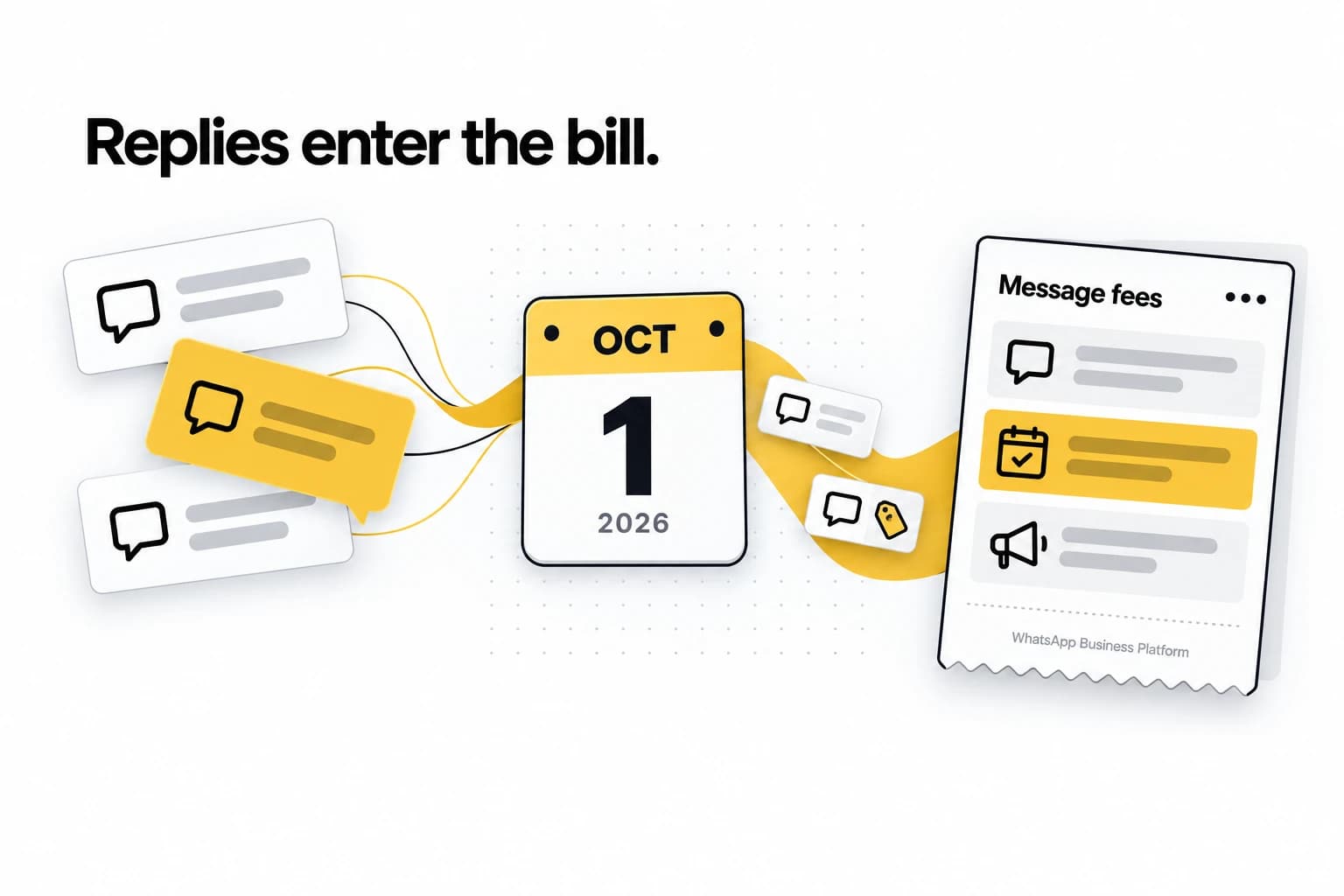
Since 1 October, those replies have been charged per message. So have utility templates sent inside that same window, which were also free.
This is not a small tweak to a rate card. It changes which habits are expensive. Here's what actually changed, what it does to a real monthly bill, and the four things worth doing before your first invoice under the new rules.
On numbers: Meta can reprice on the first day of any quarter, and did in January and July 2026. Every figure here is dated and sourced, but confirm the current rate on Meta's pricing documentation before you build a budget. There's a section at the end on reading that page yourself.
What changed on 1 October
Three things, and only the first is new news:
Service messages became billable. A "service message" is any free-form reply you send inside a customer's 24-hour window — the human or AI answering "do you have a slot Saturday?". These were free from November 2024 to 30 September 2026. Since 1 October they cost the same per message as a utility or authentication template to that country, and Meta offers no volume discount on them.
Utility templates inside the window became billable too. A booking confirmation sent while the window is still open used to ride along free. It no longer does.
Inbound stays free. When a customer messages you, that costs nothing. It never has, and that hasn't changed.
Meta's pricing documentation gives a monthly allowance of 1,000 free service messages per business phone number, resetting each month with no rollover, with charges starting at the 1,001st. A business sending fewer than about 33 replies a day per number sees no change at all.
The pricing model underneath
Worth restating, because most articles still describe a model Meta retired.
Meta charges per message, not per conversation. The conversation-window model — where you paid for a 24-hour block — was deprecated on 1 July 2025. Today, each template message you send is priced by its category and by where the recipient is.
The categories:
- Marketing — promotions, offers, "we miss you" nudges. By far the most expensive.
- Utility — order updates, booking confirmations, receipts, delivery notices. Cheap.
- Authentication — one-time passwords and login codes. Cheap. A separate, higher authentication-international rate applies when the OTP crosses borders.
- Service — your free-form replies inside the window. Free until 30 September 2026; priced like utility since 1 October.
There is one more free window most guides skip. If a conversation starts from a Click-to-WhatsApp ad or a Facebook page call-to-action, everything in that thread is free for 72 hours, templates included. If you advertise into WhatsApp at all, this is worth designing around, and it is unaffected by the October change.
Malaysia and Singapore rates
Meta has billed Malaysian and Singaporean accounts in local currency since 1 April 2026, rather than converting from US dollars. One catch: an existing Meta account cannot switch currency. Using MYR or SGD means creating a new account.
Rates below are Meta's from 1 July 2026. Its 1 October 2026 rate update changed other markets and left Malaysia and Singapore as they were.
Malaysia (MYR, per message)
| Category | Rate |
|---|---|
| Marketing | RM 0.3467 |
| Utility | RM 0.0564 |
| Authentication | RM 0.0564 |
| Authentication-international | RM 0.1685 |
| Service | RM 0.0564 (free until 30 Sep 2026) |
Singapore (SGD, per message)
| Category | Rate |
|---|---|
| Marketing | S$0.0937 |
| Utility | S$0.0205 |
| Authentication | S$0.0205 |
| Service | S$0.0205 (free until 30 Sep 2026) |
Two things to notice. Marketing costs roughly five to six times what utility costs — that ratio should shape how you use the channel far more than the absolute numbers do. And service messages are priced at the utility rate, which is the cheap end. This change is not the cliff some headlines suggested.
What it does to a real bill
A mid-sized salon in Kuala Lumpur, one business number, in a typical month:
- 400 inbound enquiries. Free, before and after.
- 1,200 replies across those conversations — roughly three messages per enquiry to answer, quote and confirm.
- 300 booking confirmations and day-before reminders, sent as utility templates.
- One promotional broadcast to 800 past customers.
| Before 1 Oct | From 1 Oct | |
|---|---|---|
| Inbound (400) | Free | Free |
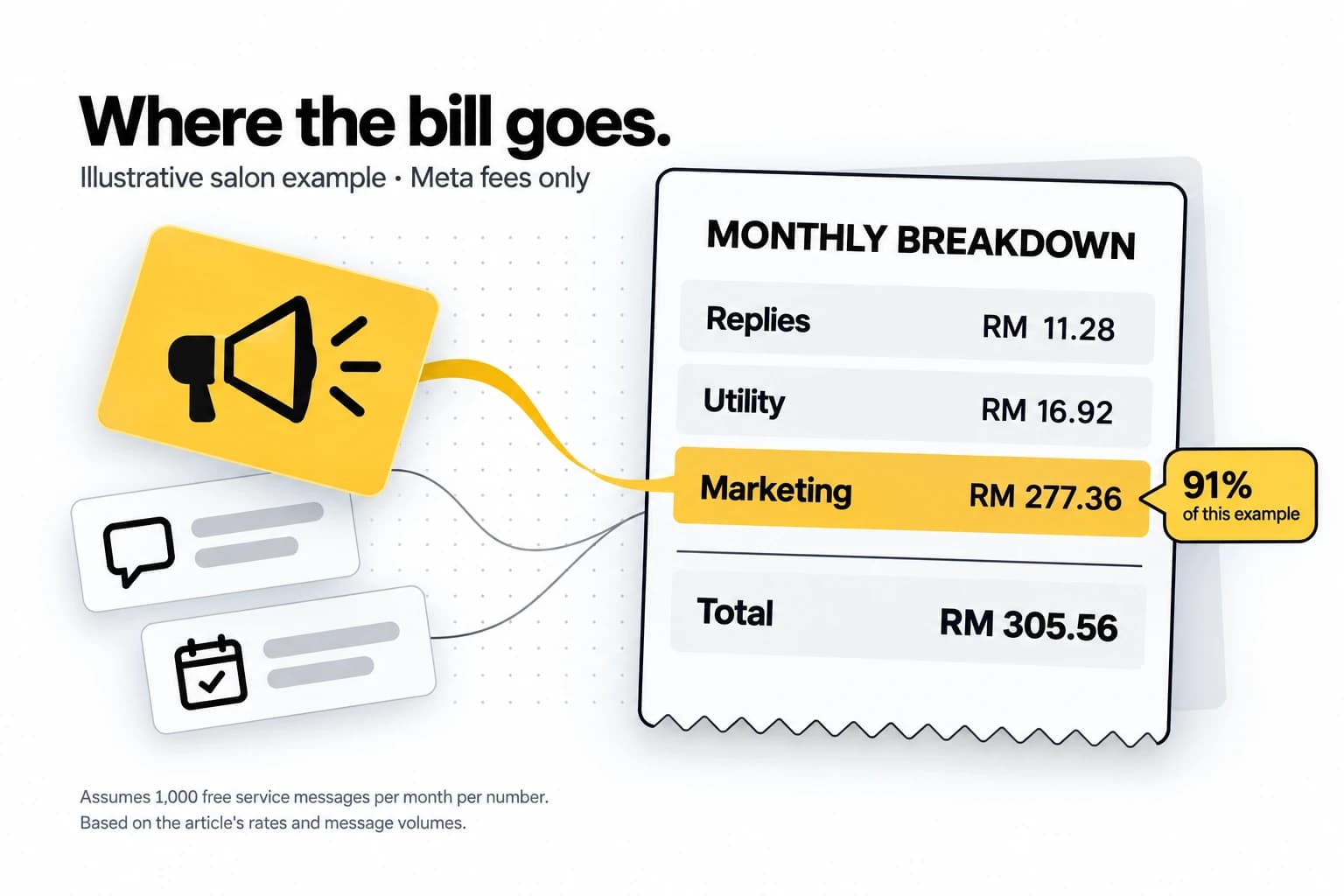
| Replies (1,200) | Free | 1,000 free, then 200 × RM 0.0564 = RM 11.28 |
| Utility templates (300) | RM 16.92 | RM 16.92 |
| Marketing (800) | RM 277.36 | RM 277.36 |
| Meta total | RM 294.28 | RM 305.56 |
The bill moves by about RM 11, or under 4%. Meanwhile the single promotional broadcast is 91% of it.
That is the honest headline: for a business that answers customers and broadcasts sparingly, this change is a rounding error. If your operation sends thousands of replies a month across one number, it is real money — 5,000 replies would add about RM 226 — but it is still dwarfed by what one careless marketing blast costs.
Four things worth doing now
1. Count your replies per number, not per business. The allowance is per phone number. Two branches on two numbers get two allowances. One number handling everything gets one. If you're near the line, splitting by branch may cost nothing and double your headroom.
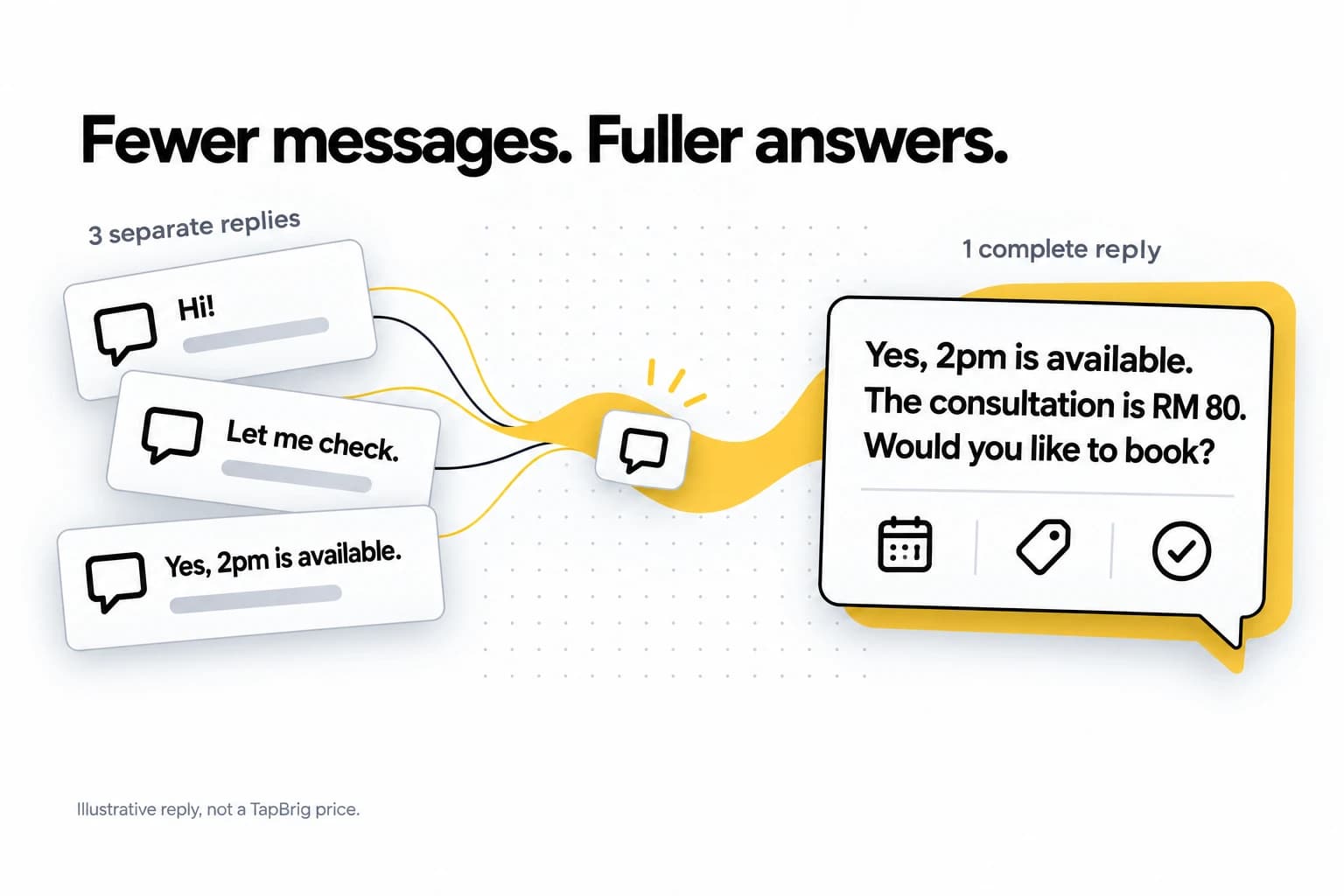
2. Write fuller replies, not more of them. This is the habit that actually changes. Under the old rules, dribbling out "Hi!", "Let me check", "Yes we have 2pm" cost the same as one complete answer — nothing. Now each of those eats into your allowance, and bills once it's gone. One message that answers the question, gives the price and offers the slot costs a third as much as three that get there eventually. It is also better service.
3. Move what you can into the 72-hour ad window. If you already run Click-to-WhatsApp ads, conversations starting there are entirely free for 72 hours, templates included. That window did not change and is now comparatively more valuable.
4. Check whether your provider marks up Meta's fees. Some add a margin on top of Meta's rates — independent reviews put one major platform at around 20% above card. On the numbers above, a 20% markup costs more than the entire October change does. Ask directly: "do you add a margin on Meta's fees, or pass them through at cost?" A provider who won't answer plainly has told you the answer.
For transparency about where we sit: TapBrig is a Business Solution Provider. We charge a flat platform fee, and Meta bills its message fees straight to your own Meta account rather than through us — so there is no line of ours for a markup to hide in. You can see the plans on our pricing page and what the product does on the WhatsApp product page.
The three bills, still
Your WhatsApp cost has never been one number. It is three, and separating them is most of the battle:
- Meta's per-message fees — the rates above. Driven by how many outbound messages you send and which category they fall into.
- The platform fee — Meta gives you an API, not an inbox. A shared inbox, automation, AI, CRM and broadcast tools come from a provider, for a monthly fee. The fair way to judge it is to ask what work it replaces: software that answers most of your enquiries is doing a part-timer's job, and should be priced against that rather than against a bare inbox.
- The extras — additional phone numbers, onboarding, extra seats, premium support. Individually small, collectively the gap between the headline price and the invoice.
If a provider quotes one "WhatsApp price" and can't break it into those three, treat that as the warning it is.
Reading Meta's rate card yourself
Rates move, this post will age, and no blog should be your source of truth for a budget:
- Open Meta's WhatsApp Business pricing documentation.
- Find the rate card and select the recipient's country — where your customer is, not where you are.
- Read across the row for the message category.
- Download the card for your billing currency if you're on MYR or SGD, since the local card is what you're actually invoiced against.
- Remember that is the Meta fee only. Add the platform fee and extras for the real total.
The bottom line
The free lunch on replies ended on 1 October 2026, and it deserves less panic than it got.
- Inbound is still free, and always was the larger half of the volume.
- Replies are priced at the cheap utility rate, not the marketing rate.
- 1,000 free replies a month per number covers a lot of small businesses entirely.
- One marketing broadcast still costs more than a month of conversations. That was true before and is more true now.
The businesses this hurts are the ones sending many short, fragmented messages at high volume. The fix is the same thing that makes for better service: answer properly the first time, fast, and don't rely on a human to be watching the inbox at 9pm to do it.
If you want a platform that answers customers in seconds, in your own tone, and never stands between you and Meta's bill, that's what we built. See what it does, or talk to us about your volumes and we'll work the numbers with you.
Rates are Meta's from 1 July 2026, unchanged for Malaysia and Singapore by its 1 October 2026 update. The change itself was checked against Meta's pricing documentation on 8 October 2026, after it took effect. Meta can change rates on 1 January, 1 April, 1 July and 1 October, so re-check at each.
See it answer your customers for a week
One AI brain across WhatsApp, web chat and digital name cards — capturing leads and sending your booking page, 24/7. Every feature, 500 AI credits, no credit card.
More from the blog
WhatsApp Automation for Salons in Malaysia: A How-To
Your WhatsApp fills up while your hands are full. Here's how to set up automation that answers from your own price list, sends your booking page and hands the tricky chats to your team, in five steps.
ReadWhatsApp Chatbot Malaysia: A Buyer's Guide (2026)
On a sales page every WhatsApp chatbot looks the same. These six questions show which ones will serve Malaysian customers well, and what you'll actually pay each month.
ReadWhat Is an AI Customer Engagement Platform? A Plain Guide for SMBs
The term is everywhere and explained nowhere. Here's what an AI customer engagement platform actually is, how it differs from a chatbot or a CRM, and why it matters for a small business.
Read